
The telephony integration gap: why business calls never reach the CRM
UK businesses have invested heavily in their software. CRMs, help desks and AI note-takers are now standard. But there is one channel that still sits awkwardly outside that stack: the phone. To understand how big that gap really is, we surveyed 50 sales, customer support and operations leaders at UK SMBs and enterprises. We asked them which tools they use, how their calls and texts reach their CRM, and where their teams lose time every day.
The short answer: most teams have a sophisticated tech stack, but their calls are not properly connected to it. Only 4 in 10 companies log calls and texts into their CRM automatically. The rest copy-paste, fix broken syncs, or lose the data altogether.
With the UK’s PSTN switch-off approaching in January 2027, many UK businesses will have to rethink their phone system anyway. This research shows what that new setup needs to get right.
Key takeaways
- The tech stack is mature. 62% of respondents use (or have used) Salesforce, 40% Microsoft Dynamics and 36% HubSpot. 72% already use AI tools such as Gong, Otter.ai or Fireflies.ai to analyse conversations.
- Telephony is the weak link. 40% of organisations have no dedicated business phone system and rely on Teams, Zoom, personal mobiles, WhatsApp or eSIMs instead.
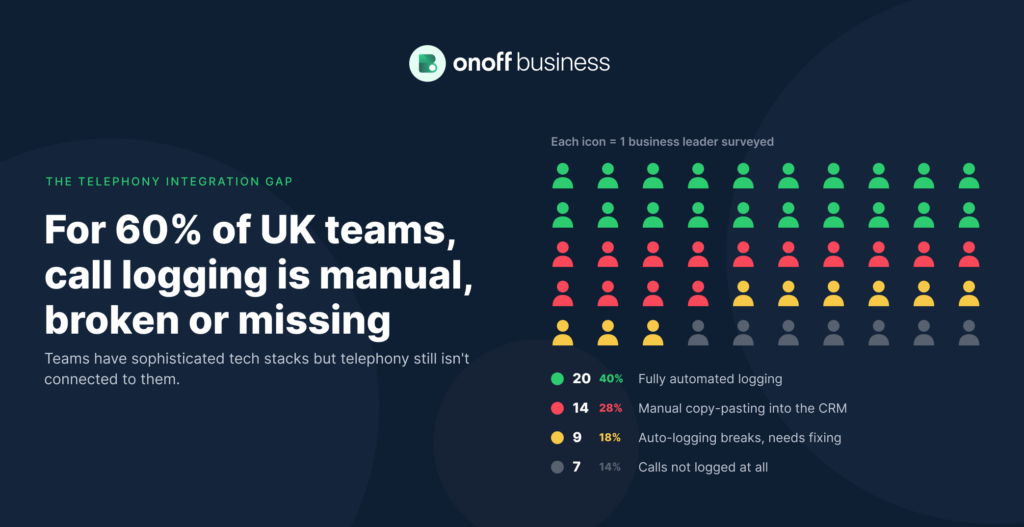
- 60% of companies don’t have reliable call logging. 28% copy-paste call notes by hand, 18% have auto-logging that regularly breaks, and 14% don’t log calls or SMS at all.
- Workarounds create new problems. 40% connect their phone system to the CRM via Zapier, Make or in-house code, and 26% say new CRM contacts don’t sync to their phones in time to recognise callers.
- Tool-switching is the #1 daily headache (32%), ahead of contact sync delays (26%) and lack of shared call history (22%).
- Support and operations feel it most. Customer support and success (64%) and operations (44%) are the teams pushing hardest for a better phone setup.
About the research
We surveyed 50 decision-makers in sales, customer support and operations at small, mid-sized and enterprise organisations in the UK. The survey was part of a wider research programme to understand the day-to-day friction teams face between their phone system and the rest of their software.
Note: some questions allowed several answers, so percentages within those questions do not add up to 100%.
Finding 1: The software stack is advanced but calls sit outside it
The companies we spoke to are not tech laggards. Their core platforms are the big names of business software:
CRM / customer platform | Share of respondents |
|---|---|
Salesforce | 62% |
Microsoft Dynamics | 40% |
HubSpot | 36% |
Zendesk Sell / Support | 34% |
Zoho CRM | 28% |
AI is already part of the workflow too: 72% use AI tools like Otter.ai, Fireflies.ai or Gong to record and analyse customer conversations.
Why it matters: these tools are only as good as the data they receive. If a large share of phone calls never reaches the CRM, sales forecasts, customer histories and AI insights are all built on an incomplete picture.
Finding 2: 4 in 10 companies have no real business phone system
How teams make business calls | Share of respondents |
|---|---|
A dedicated cloud telephony platform | 60% |
No dedicated system (Teams, Zoom, mobile SIMs, WhatsApp, eSIMs) | 40% |
Six in ten organisations use a dedicated cloud phone system. The other four patch things together: video-conferencing tools, personal or company mobile SIMs, WhatsApp and eSIMs.
Why it matters: calls made from a personal mobile or WhatsApp are usually not recorded, not logged and not visible to the rest of the team. When an employee leaves, their customer conversations, and often the customer relationships, can leave with them.
Finding 3: Most teams still log calls by hand, or not at all
Automatic call logging is often promised, but rarely achieved. We asked how calls and texts get into the CRM or help desk:
How calls and SMS are logged | Share of respondents |
|---|---|
Fully automated, no extra effort | 40% |
Manually copy-pasted (notes, call length, texts) | 28% |
Automated, but often needs manual fixes | 18% |
Not logged anywhere | 14% |
In other words, 60% of companies cannot fully trust their call data. Almost a third of teams spend time after every call typing notes into the CRM. Nearly one in five has set up automation, but still has to chase missing recordings, wrong contact details or broken logs. And one in seven has no record of phone or SMS conversations at all.
So, manual logging takes time away from customers, and it is the first thing people skip on a busy day. The result is a CRM with gaps exactly where the most important conversations happened.
Finding 4: DIY integrations are slow and fragile
When the phone system and the CRM don’t talk to each other natively, teams build their own bridges:
These workarounds are better than nothing, but they introduce delays and maintenance work. 26% of leaders say newly created CRM contacts don’t sync to their phone system straight away. So when a new lead calls back, the agent sees an unknown number instead of a name, a company and a history.
Why it matters: the first seconds of a call set the tone. Not recognising a customer who just filled in a form, or who called yesterday, makes the company look disorganised — and forces the customer to repeat themselves.
Finding 5: Switching between apps is the biggest daily headache
We asked leaders to name their main operational pain points:
Top operational headaches | Share of respondents |
|---|---|
Switching between the phone app and other tools | 32% |
Contacts not syncing instantly | 26% |
No shared view of call and SMS history | 22% |
Slow or incomplete call logging | 20% |
The common thread: the phone works on its own, separate from everything else. People dial in one app, look up the customer in another and write notes in a third. Each switch is small, but across a team and a full day it adds up to hours of lost focus.
What this means for UK businesses
If you are reviewing your phone system, whether because of the PSTN switch-off, team growth or simple frustration, the research points to five questions worth asking any provider:
- Are calls and texts logged in the CRM automatically, with no copy-pasting and no manual fixes?
- Does the integration work natively with the CRM you already use, or will you need Zapier or custom code?
- Do new contacts sync instantly, so your team recognises callers from the first ring?
- Can your team call and text from the tools they already use (CRM, browser, Microsoft Teams), instead of switching apps?
- Are mobile calls covered too? If your team works on mobiles, calls made on the go should be logged and recorded just like calls from a desk.
How Onoff Business closes the gap
Each finding in this research shaped how we built Onoff Business for UK teams.
What the research found | How Onoff Business responds |
|---|---|
40% have no dedicated phone system and rely on personal mobiles, WhatsApp or eSIMs | Professional cloud numbers on any smartphone or computer, separate from personal calls, no new hardware and no extra SIM card required |
60% don’t have reliable call logging | Calls and SMS are logged automatically in your CRM, with call recording available |
40% rely on Zapier, Make or in-house code | Native integrations with Salesforce, HubSpot, Pipedrive and Odoo, plus an API and webhooks for custom workflows |
26% suffer contact sync delays | CRM contact details shown directly in the Onoff app, so your team knows who is calling |
32% lose time switching between tools | Click-to-call from your computer or any web page, and calls and SMS from Microsoft Teams |
22% lack shared visibility of calls | One admin console to assign numbers, manage IVR and recording, and see your team’s call statistics |
The phone needs to join the rest of the stack
Based on our research, six in ten UK businesses still log calls by hand or rely on fragile workarounds to get them into the CRM. In sales, that shows up as gaps in the pipeline. In support and operations, the cost is felt sooner. A customer rings back, the person who answers has no record of the last conversation, and the customer has to explain everything again.
For most of these companies, the issue is no longer which phone system to buy. What matters is where the call data goes once the call ends. If calls are logged automatically, synced with the CRM in real time and visible to the whole team, the phone becomes part of the same system as email, chat and tickets. Until then, the most direct conversations a business has with its customers will stay the ones it knows least about.
Your phone, finally connected to your CRM
Calls are logged automatically and synced in real time, and the whole team can see them in the tools they already use.